.png)

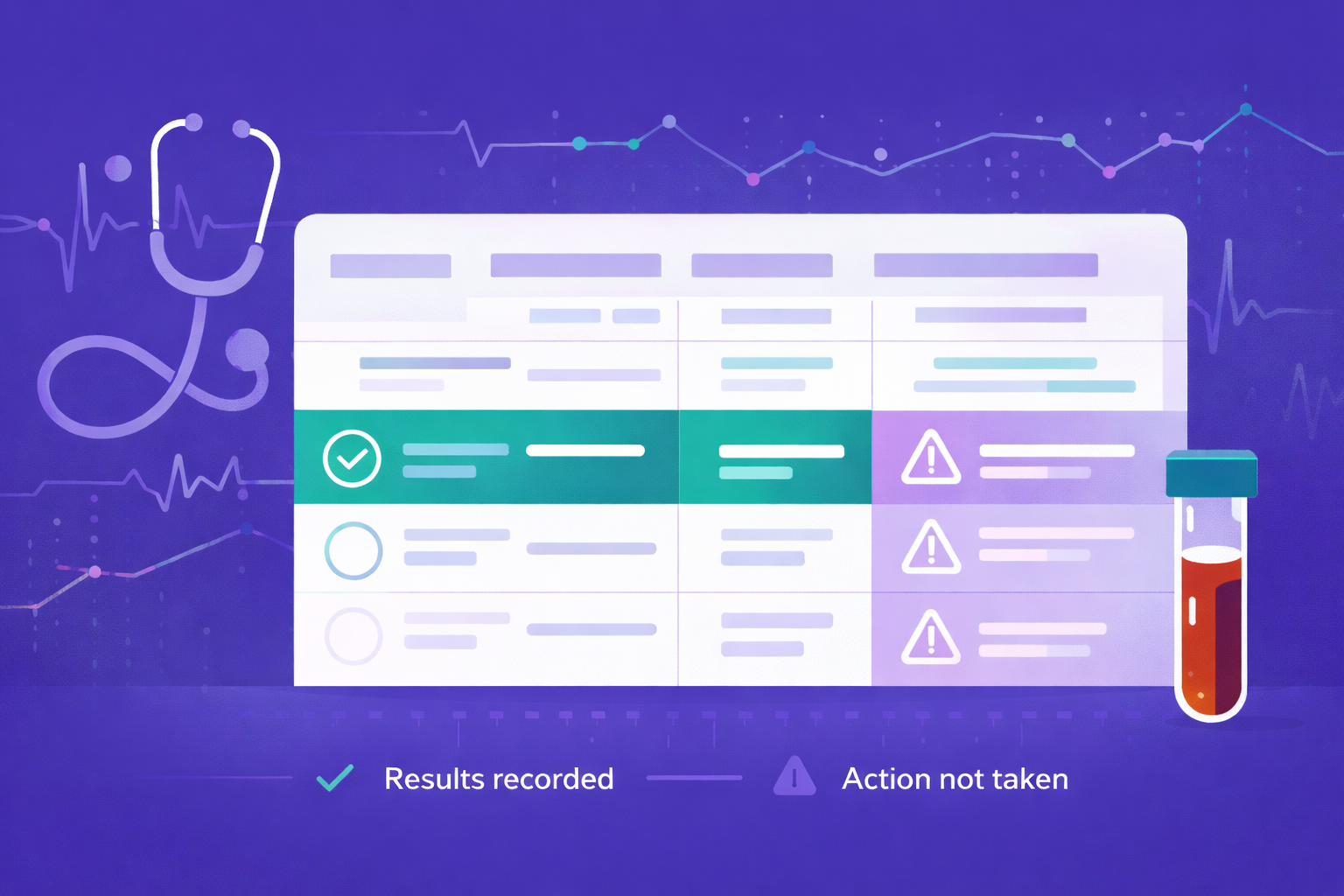


A patient comes in for their annual health screening. Blood is drawn, tests are run, a chest X-ray is taken. Results are processed. Two days later, they receive a report — pages of reference ranges, flagged values in red, and clinical terminology that means very little to them without a medical degree.
They glance at it. Nothing looks obviously alarming. They file it away.
What the report did not tell them: at 57, with a 25 pack-year smoking history and a borderline chest X-ray finding, they were a textbook candidate for a low-dose CT lung cancer screen. It did not tell them that their slightly elevated fasting glucose, modest creatinine rise, and blood pressure trending upward together suggest early metabolic risk worth investigating further. It did not prompt a colonoscopy they were three years overdue for.
Six months later, that patient is referred to a pulmonologist with a suspicious nodule that could have been detected — and staged differently — had the right next step been taken at the right time.
This is not a rare scenario. It is playing out every day in clinics across Asia. And the uncomfortable truth is that the health screening report — the final product of an entire care process — is often where the clinical value gets lost.
Health screening exists for one purpose: to identify risk early enough to act on it. But identifying risk and communicating risk are two entirely different things. Most clinics do the first reasonably well. Most clinics struggle badly with the second.
The traditional health screening report was designed to document results, not to guide action. It presents raw data — lipid panels, eGFR values, fasting glucose readings — with reference ranges but without context, prioritisation, or a clear call to action. For a patient without clinical training, that report is difficult to interpret and even harder to act on.
Research published in the Annals of Family Medicine confirms this is not a niche problem: limited health literacy is independently associated with poorer understanding of chronic diseases, reduced use of preventive services, and higher hospitalisation rates. Patients who cannot make sense of what their results mean are unlikely to act on them — and that gap between data and behaviour is where clinical risk quietly accumulates.
The consequences compound at every step:
The report, in other words, is not just a communication problem. It is a clinical risk.
One of the most significant weaknesses of conventional health screening reports is their reliance on binary thresholds. A value either falls within the reference range, or it doesn't. Red flag, or no red flag.
This approach misses the clinical story that lives between the data points.
Consider a patient with fasting glucose at the high end of normal, slightly elevated blood pressure, and a modest uptick in creatinine — all individually within reference range, all individually unremarkable. Reviewed in isolation, nothing is flagged. Reviewed together, they form a recognisable metabolic pattern that significantly elevates risk for type 2 diabetes and chronic kidney disease within the next decade.
Standard reporting doesn't make that connection. A clinician reviewing a high volume of results under time pressure may not either.
This matters enormously in the Asia-Pacific context, where the metabolic disease burden is both large and growing. Southeast Asia recorded a 59.5% rise in type 2 diabetes prevalence between 1990 and 2019, and the International Diabetes Federation's 2024 Atlas estimates that 1 in 2 adults living with diabetes across the Western Pacific region — which includes Singapore, Malaysia, Indonesia, the Philippines and Hong Kong — remain undiagnosed. These are not patients who have slipped through a broken system. Many have attended health screenings. Their data exists. The problem is that reports generated from that data are not surfacing the risk clearly enough to prompt action.
Binary threshold problems apply to results that were collected. But there is an equally significant gap in what health screening reports do with results that weren't collected at all.
A comprehensive health screen generates a picture of a patient at a moment in time: their labs, their vitals, their imaging where it was taken. What most reports do not do is ask the logical follow-on question: based on this patient's age, risk factors, and clinical profile, what else should they be doing?
This is the referral gap — and it has direct consequences for cancer detection.
More than half of the world's cancer cases and mortality now occur in Asia, yet cancer screening rates across the region remain far below where clinical evidence says they should be. The reasons are well documented: lack of awareness, fragmented pathways, and — critically — health screening encounters that do not systematically translate risk profiles into referral prompts.
Consider what evidence-based clinical guidelines recommend for a typical cross-section of health screening attendees:
A 55-year-old with a significant smoking history should be considered for low-dose CT lung cancer screening. Yet a meta-analysis published in early 2026 found that the pooled LDCT uptake rate for lung cancer screening across Asian populations was just 46% — and that was among those in active screening programmes. Outside structured programmes, participation is substantially lower.
A woman aged 50 or above presenting for a general health check should have her mammography status assessed and, where overdue, be prompted toward breast cancer screening. Most routine health screening reports do not surface this.
A patient aged 50 and above, particularly with relevant family history or prior findings, warrants a conversation about colorectal cancer screening — colonoscopy or an appropriate alternative. That conversation rarely originates from a standard health screening report.
For clinic operators, the implications extend beyond clinical outcomes. Lung CT, colonoscopy, and mammography are significant revenue-generating procedures. They require referral pathways — and referral pathways require a trigger. When the health screening report is the point of contact between a patient and the broader care system, and that report fails to generate the appropriate referral, the clinic loses both the clinical value and the commercial opportunity.
A research review of health checkup programmes in Japan found that comprehensive health checkups can detect cancer in more than twice the number of individuals reported through standard metrics — but only when proper follow-up and referral processes are in place. The detection potential exists. The infrastructure to act on it, in most clinics, does not.
Patients who receive a report they don't understand are less likely to return for follow-up appointments. They are less likely to act on referral recommendations. They are less likely to see the value in annual screening at all. In a private healthcare market where patient retention and corporate contract renewal depend on demonstrated outcomes, a report that doesn't change patient behaviour is a liability.
At the same time, the operational cost of generating those reports manually — or semi-manually — is significant. In high-cost labour markets across the region, the clinician and administrative hours consumed by report generation are hours not spent on direct patient care. Screening volumes are growing. Headcount is not.
The result is a system under pressure at both ends: clinically, in the quality of insights being communicated; operationally, in the cost and speed of generating them.
Health screening is valuable. The data collected in a standard annual screen — lab results, imaging, clinical observations — represents a genuine window into a patient's current and future risk. If properly interpreted and clearly communicated, it can change outcomes across metabolic disease, kidney disease, and cancer alike.
But that value is entirely contingent on the quality of what happens after the patient leaves the room. A report that presents results without context, fails to surface cross-marker patterns, and misses the referral prompts that clinical guidelines call for is not delivering on that potential.
The question worth asking is not whether your clinic is collecting the right data. It almost certainly is. The question is whether your reports are doing anything meaningful with it.
In the next post in this series, we explore what the research says specifically about chronic kidney disease in Hong Kong — one of the most under-detected serious conditions in the region, and a clear test case for what smarter health screening interpretation could achieve.
Mesh Bio provides AI-powered health screening software for healthcare providers across Asia. To see how DARA transforms health screening reporting, clinical decision support, and referral pathways, book a 20-minute walkthrough.
References

