.png)

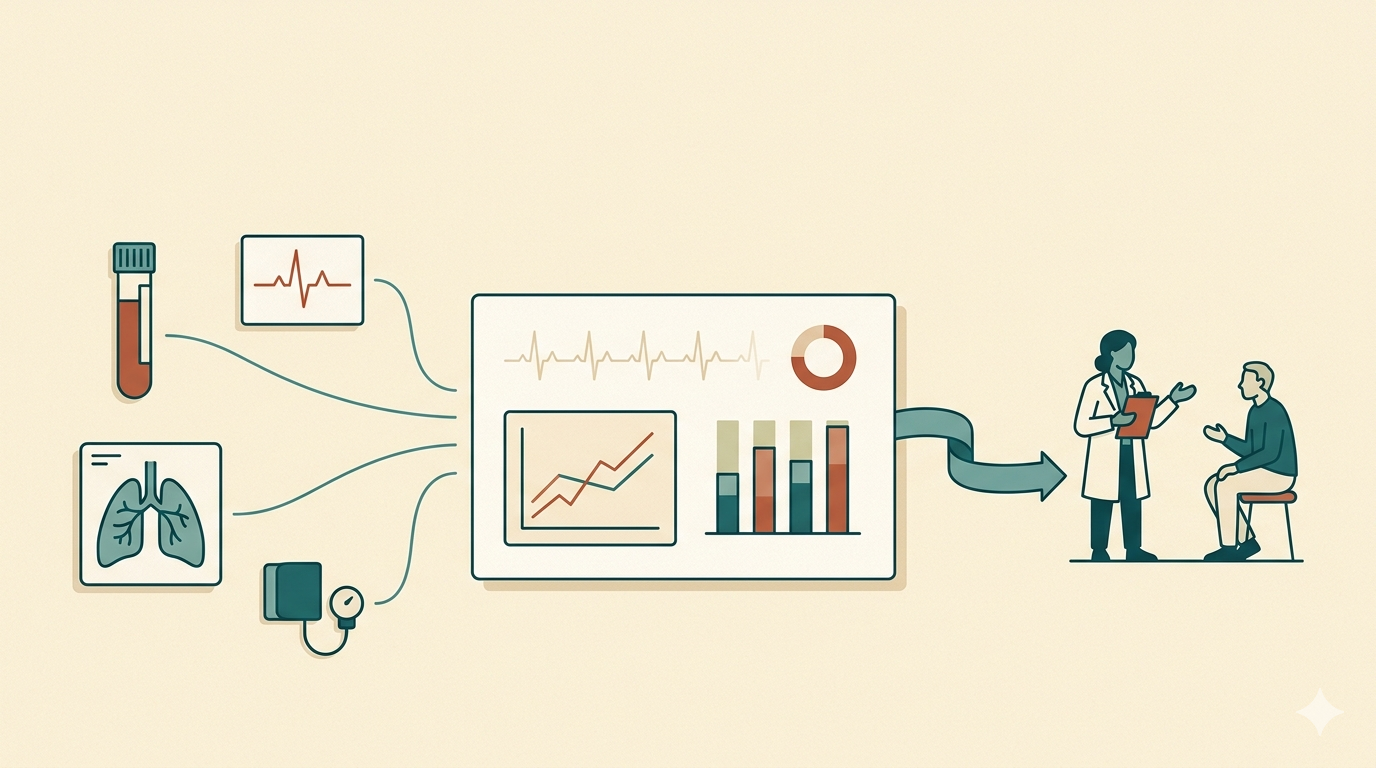


The bottleneck in modern preventive care isn't lab capacity — it's interpretation.
Most health screening operations have invested heavily in the front of the funnel. Slicker booking. Faster phlebotomy. More comprehensive test panels. But the choke point has quietly shifted to what happens after the results come back: a clinician, often working from a thick PDF and their memory of guidelines, deciding what to recommend, what to flag, and whether to refer. Multiply that by thousands of executives a year, and the math stops working.
DARA® is built for that bottleneck. Three things every screening operator should now expect from AI — workflow fit, speed of insight, and measurable outcomes.
Screening volumes are climbing across Singapore, Hong Kong, and the rest of Southeast Asia — driven by corporate health programs, executive packages, and a growing public awareness of chronic disease risk. The supply side, meanwhile, hasn't scaled with it. Three failure patterns recur in every operator we speak with:
Each one is a margin problem on its own. Together, they form a structural ceiling on how much screening you can profitably do.
Automation that fits your operation, not the other way around.
AI in screening usually gets discussed in terms of the report it produces. The quieter, larger value is in everything that happens around the report.
Before any clinical review can begin, every component of a screening — labs, imaging, ECG, spirometry, and other assessments — needs to be complete and in one place. DARA tracks completeness automatically, flagging missing or pending results and removing the manual back-office work of compiling each patient's file for review.
Once results are in, DARA auto-generates personalized clinical follow-ups and lifestyle guidance for each patient. Referrals route through your own downstream services — specialists, allied health, chronic disease programs — so patients stay inside your network. For tests requiring specialist interpretation, DARA opens a templated channel between your team and external specialists across any CMS, and folds the response back into the patient record.
Critically, none of this requires you to rebuild your tech stack. We've integrated DARA across the full spectrum of health IT — from clinic management systems to large hospital EHRs like Epic, plus FHIR/HL7, CSV, and PDF — so it sits alongside what you already run.
The operational payoff is throughput. One executive screening provider scaled from 20,000 to 30,000 patients per year on the same headcount — a 50% gain by removing manual interpretation as the constraint. Your lift will vary, but the mechanism doesn't: clinicians spend less time on data wrangling and more on judgment.
From data dump to decision in 20 seconds.
DARA produces a complete health screening report in approximately 20 seconds, drawing on a portfolio of clinically validated risk calculators covering cardiovascular disease, diabetes, hypertension, chronic kidney disease, and non-alcoholic fatty liver disease. Each calculator uses the prediction horizon its evidence base supports — some 10 years, others shorter or longer. Not a triage screen — a clinician-grade report.
The clinical logic is built in three layers: international best practices (WHO, International Diabetes Federation), national clinical guidelines where they exist (Singapore MOH, and equivalents in Malaysia and Hong Kong), and customization to each provider's preferred protocols. Globally credible, locally appropriate, operationally yours.
The engine maps over 7,000 clinical scenarios against each patient's age, gender, history, and biomarkers. That breadth matters — the same reading means different things in different patients. An LDL of 3.0 mmol/L is unremarkable in a healthy adult; in a patient with diabetes, it's a flag to adjust medication. DARA encodes that nuance natively.
For a Medical Director, the implication is simple: every patient gets the same evidence-grounded analysis your most senior consultant would deliver — every time, without the wait. With an attached lab, that can mean same-day or within-hours turnaround. With an outsourced lab, one operator went from 18 calendar days to 8. Your numbers depend on your setup, but the direction is consistent.
Outcomes that show up on the P&L and in the patient panel.
"Better outcomes" is the phrase that gets thrown around most loosely in healthcare AI. With DARA, it lands in three concrete places:
"Better outcomes" isn't a soft benefit. It compounds — through retention, follow-up program conversion, and revenue per screening — into the metrics your CFO actually tracks.
DARA is deployed at 40+ medical groups across Singapore, Malaysia, Hong Kong, and other Southeast Asia markets — supporting hundreds of thousands of patient checkups, with each implementation tuned to local clinical guidelines and provider workflows.
The platform complies with ISO 27001 (information security) and ISO 13485 (medical devices) certifications. The HealthVector® Diabetes module is HSA-approved for clinical use in Singapore.
If you run a screening business at any meaningful scale, the question isn't whether AI will reshape preventive care. It's whether your operation will be doing the reshaping or being reshaped by competitors who got there first.
The fastest way to evaluate DARA is to watch it run on a real case in your context.
Book a 30-minute demo — we'll walk through an end-to-end health screening report in the time it takes to drink a coffee.

