.png)

.png)

In modern healthcare, patient engagement isn’t just nice to have — it’s a key driver of better outcomes. Engaged patients who actively participate in managing their own health are more likely to follow treatment plans, catch early warning signs, and avoid preventable hospitalizations. Low engagement, on the other hand, often leads to delayed interventions, higher costs, and poorer quality of life.
Predictive health tools — from AI risk scoring to wearable-driven analytics — can shift this dynamic. By analyzing patient data and flagging risks before they happen, these tools can empower patients to act earlier and prevent adverse events.
But here’s the catch: Technology alone won’t spark engagement. Without trust, clear communication, and thoughtful integration, even the most advanced tools risk being ignored. Clinics must bridge that gap by turning predictions into clear, motivating actions patients can understand and embrace.
Even accurate predictions fall flat if patients aren’t engaged. Common barriers include:
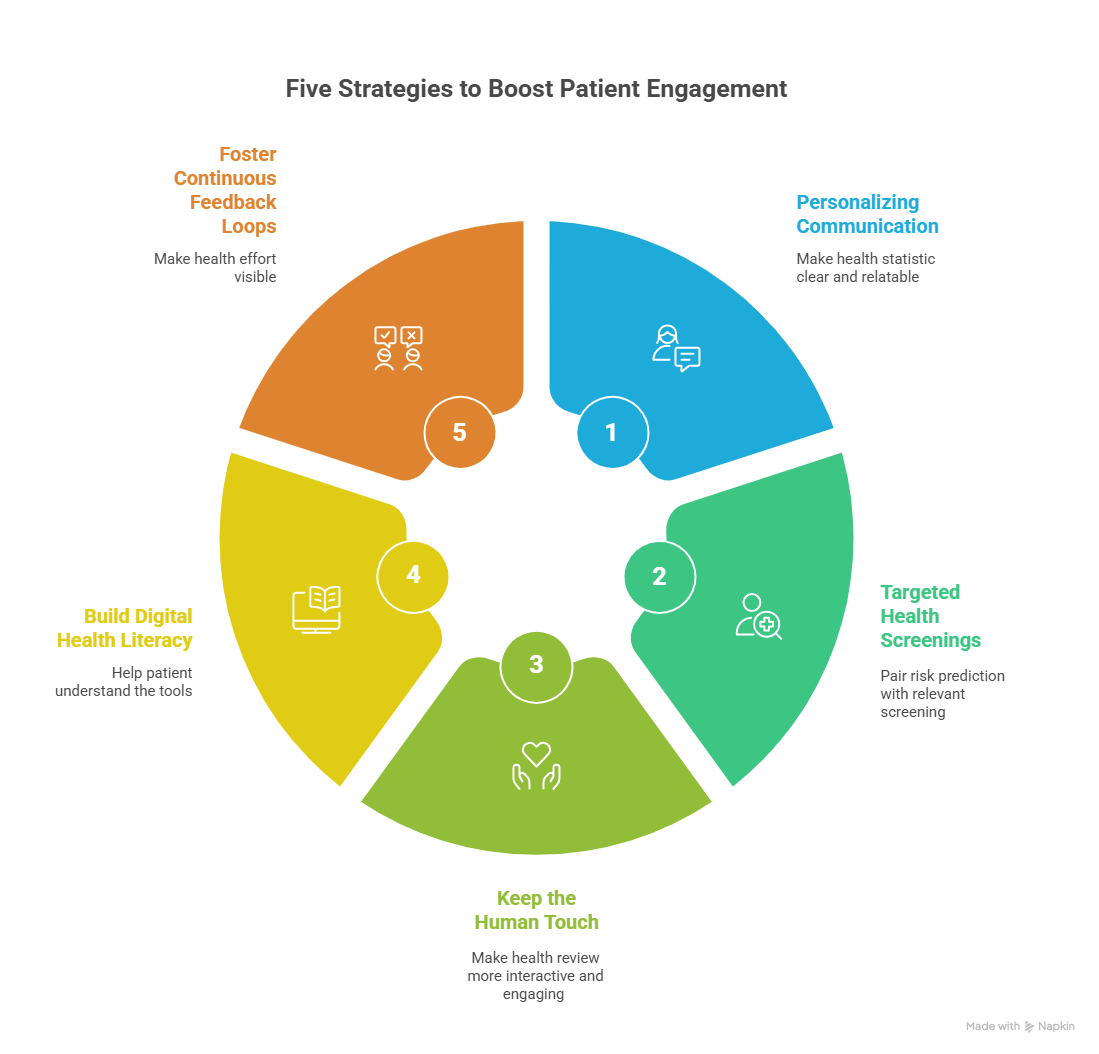
Population-level statistics rarely change individual behavior. But personalized, patient-specific risk information — when clearly explained — can motivate individuals to act.
Instead of: “You have a 30% risk of developing diabetes in 5 years.”
Try: “Your current health data suggests you may be at higher risk of developing diabetes. Here’s what the next steps could look like to help reduce that risk.”
Example in practice: Using Mesh Bio’s Human Digital Twin platform, clinicians can access a structured, longitudinal representation of a patient’s health status and risk factors. This supports clearer communication by helping clinicians contextualize risk within the patient’s own data patterns — making discussions more relevant and easier to understand.
A prediction is only useful if it leads to timely, relevant action.
Example in practice: Based on a patient’s digital twin profile, clinics using Mesh Bio Health Screening Module can recommend screenings tailored to individual risks. For instance, if the model shows elevated liver health concerns, liver function tests can be prioritized — making recommendations feel more relevant and boost screening uptake.
Predictive tools should enhance — not replace — clinician-patient interactions. Patients trust insights more when clinicians take time to explain how results are generated and why they matter.
Example in practice: With Mesh Bio’s evolving Human Digital Twin, each new lab result or vital sign updates the patient’s profile. Clinicians can use these updates during consultations to discuss progress, adjust treatment, and celebrate improvements — turning each visit into a collaborative review rather than a one-way lecture.
Not all patients know how to navigate predictive tools and interpret health data. Clinics can bridge this gap by:
Example in practice: When deploying Mesh Bio digital twin-based solutions, some clinics hold group sessions to walk patients through their scores and show them how to track improvements over time. This hands-on approach builds confidence, strengthens understanding, and boosts long-term engagement.
Patients stay more engaged when they can see how their efforts make a difference.
Example in practice:
By leveraging Mesh Bio’s Disease Management solution, clinics can build stratified outreach campaigns to segment patients by risk level and deliver them tailored follow-up plans, lifestyle programs, or educational content — keeping patients engaged between visits and showing how their actions affect their risk.
A collaboration between Mesh Bio and Tan Tock Seng Hospital (TTSH) demonstrates how predictive health tools can deliver real-world impact. Using Mesh Bio’s HealthVector® Diabetes — an AI-powered predictive risk stratification system — the care teams can identify high-risk diabetes patients earlier, prioritize follow-up, and intervene sooner. This targeted approach helps optimize resources, improve outcomes, and prevent avoidable complications.
The next generation of predictive health tools will integrate continuous sensor data, genomic insights, and real-time analytics to deliver risk assessments with unprecedented accuracy. As these capabilities grow, ethical AI practices, transparent data policies, and equitable access will be critical to maintaining trust.
But the true breakthrough won’t just be in predicting disease — it will be in engaging patients to act on those predictions. Tools like Mesh Bio’s Human Digital Twin can shift healthcare from reactive to proactive, but technology alone isn’t enough. The clinics that thrive will be those that pair data-driven insights with clear communication, patient education, and a genuine human connection.
Discover how next-generation clinical intelligence can transform your practice.
👉 Contact us today to schedule a demo and experience the power of Human Digital Twins Technology.
At Mesh Bio, we work with healthcare systems, life sciences leaders, and research institutions to bring Digital Twin technology into clinical practices—helping healthcare providers and patients make smarter, faster, more personalized decisions.
✅ Make faster, more confident clinical decisions
✅ Deliver more effective, personalized care for every patient
✅ Reduce clinical uncertainty and risk through real-time predictive insights
✅ Improve operational efficiency and patient outcomes
✅Drive the future of evidence-based medicine

